Matrimonial Real Property
As of December 16, 2014 all sections of the Family Homes on Reserves and Matrimonial Interests or Rights Act (FHRMIRA) came into effect. It is important to note that the death of a spouse or the separation of a married or common-law couple, on or before December 15th, 2014, will not fall under the Provisional Federal Rules of FHRMIRA.
FHRMIRA applies to married couples and common-law partners living on reserve, where at least one of them is a First Nation member or an Indian as defined in the Indian Act. FHRMIRA seeks to provide basic protections and rights to individuals living on reserves regarding the family home and other matrimonial interests and/or rights, during a conjugal relationship, in the event of a breakdown of that relationship, and on the death of a spouse.
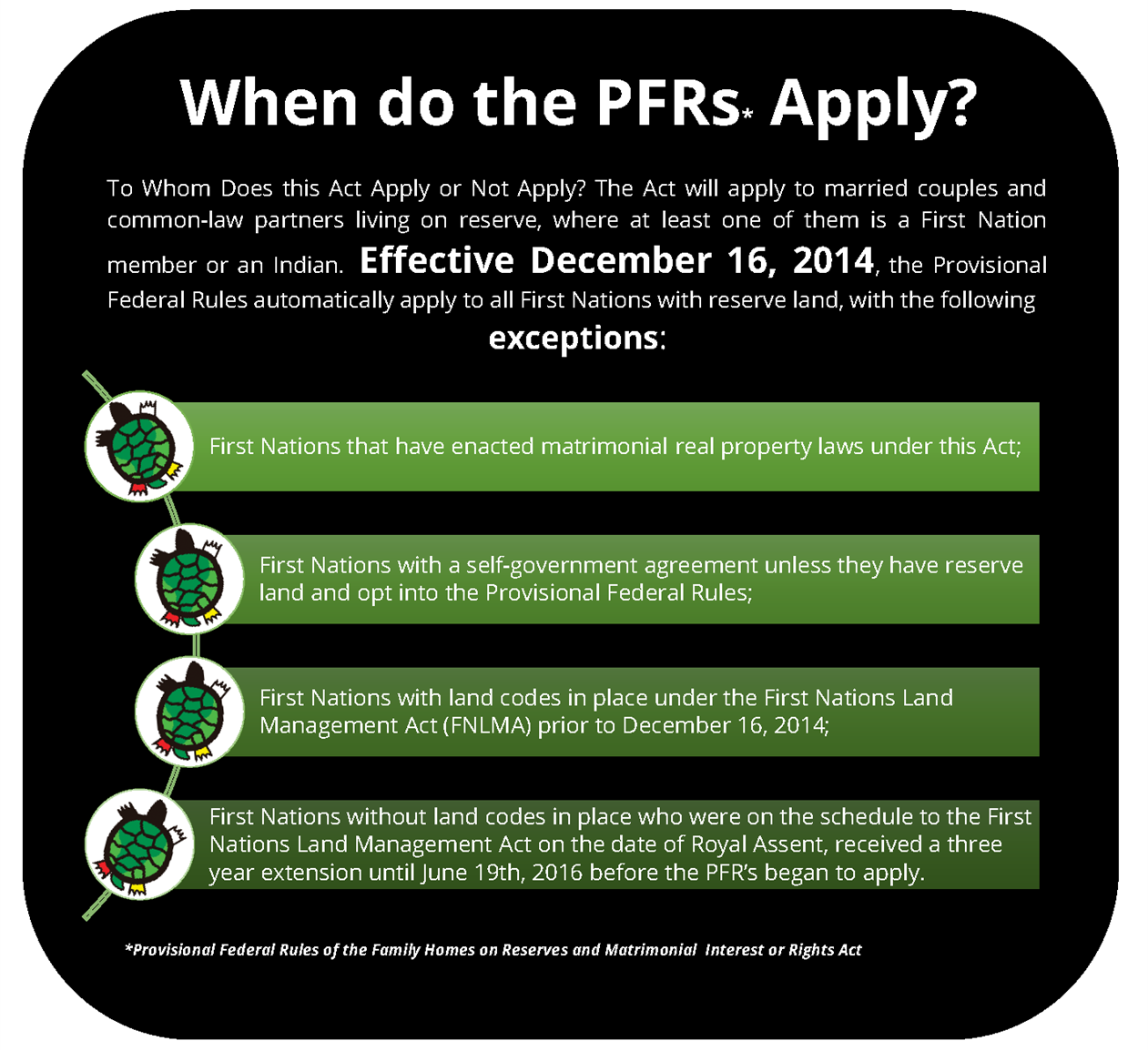
FHRMIRA includes an interim set of Provisional Federal Rules that provide specific protections to individuals living on reserve until a First Nation community establishes its own Matrimonial Real Property (MRP) law under FHRMIRA or other Federal Legislation. What rights and protections do the Provisional Federal Rules (PFR) in the Act provide?
The PFRs provide the following rights and protections:
-
Equal right to occupancy of the family home
-
Requirement of spousal consent for the sale or disposal of the family home
-
Emergency Protection Orders
-
Exclusive Occupation Orders
-
Entitlement of each member spouse or common-law partner to an equal division of the value of the family home and any other matrimonial interests or rights
-
Order for the transfer of matrimonial real property between member spouse or common-law partners
FHRMIRA deals with what is referred to as Matrimonial Real Property (MRP). The family home is the most common type of MRP. The Provisional Federal Rules, which are now in effect, provide specific protections, including the requirement for spousal consent for any transfers or encumbrances of reserve land on which the family home is situated.
You must determine which rules apply on your First Nation.
-
If your First Nation is signatory to either the First Nation Land Management Act (FNLMA) or a Self-Government Agreement, then FHRMIRA may not apply to you.
-
However, depending on your FNLMA status on the date of Royal Assent, June 19, 2013, these rules may or may not apply to your First Nation. For specific information on the applicability of this legislation to your First Nation, please contact your advisor at the Lands Advisory Board or the National Aboriginal Lands Managers Association.
-
If your First Nation has enacted its own MRP law under FHRMIRA, the Provisional Federal Rules no longer apply.
ISC has required forms to capture information related to cases under FHRMIRA. In the pages that follow, we provide examples and notes to help you understand and complete the forms.
The various forms in this Quick Reference Guide may be changed or modified over time as more case experience with this new legislation is gained. It is prudent to ensure that you are using the most up-to-date forms when dealing with cases of matrimonial real property. You can also contact the Centre of Excellence for Matrimonial Real Property for assistance in these matters.
There are five forms that deal with aspects of changes in Matrimonial Real Property ownership.
The forms include:
-
The Assessment of Matrimonial Real Property and Statutory Declaration form. This form is used by a member of a First Nation who owns land on the reserve and wants to submit a land transaction affecting that land. The purpose of the form is to establish whether an interest in, or to, the family home is affected by the proposed transaction, and whether the free and informed consent has been given by the other spouse or common-law partner to proceed with the land transaction.
-
The Statutory Declaration of Spouse or Common-Law Partner form. This form must be completed by the spouse of a First Nation member where this member owns land on which the family home is situated and who wants to submit a land transaction affecting that land. The Statutory Declaration of Spouse or Common-Law Partner form is used to show that consent has been obtained.
-
The Statutory Declaration of Executor of a Will or an Administrator of an Estate form. This form is used by the Executor of the Will
 The legal statement concerning the disposition of one's property after death; the document containing such wishes or the Administrator of the Estate of a deceased member of a First Nation. This consent form requires the Executor of Will or Administrator of Estate to declare that they will observe provisions of the Indian Act or Family Homes on Reserves and Matrimonial Interests or Rights Act in carrying out their duties.
 -
The Statutory Declaration of Executor of a Will or Administrator of an Estate and Surviving Spouse or Common-Law Partner form. This form is used by the surviving spouse who is also the Executor of the Will or the Administrator of the Estate of a deceased member of a First Nation. This form must be completed by the Executor or Administrator wanting to distribute the estate of a deceased individual who died after December 15, 2014 and held an interest on reserve, in order to demonstrate compliance with s. 38(1) of the Family Homes on Reserves and Matrimonial Interests or Rights Act (FHRMIRA). Pursuant to s. 38(1) of the act, an Executor of a Will or an Administrator of an estate must not proceed with the distribution of the estate until one of the following occurs:
-
the survivor consents in writing to the proposed distribution;
-
the period of 10 months referred to in subsection 36(1) and any extended period the court may have granted under subsection 36(2) have expired and no application has been made under subsection 36(1) within those periods; or
-
an application made under subsection 36(1) is disposed of.
-
-
The Statutory Declaration of the Surviving Spouse or Common-Law Partner form. This form is used to obtain the consent of the surviving spouse of a deceased member of a First Nation. In certain circumstance the Executor of a Will or Administrator of an Estate will seek consent from the surviving spouse, the surviving commn-law partner(s), or both as required. For clarity, in some cases, there may be a spouse (e.g., the couple remain legally married but are separated) and also a common-law partner(s). In that case, the form Statutory Declaration of the Surviving Spouse or Common-Law Partner must be completed by the spouse and the common-law partner(s).